Homepage /

Content

Contents


Xydalba™ Indication

Xydalba™ is indicated for the treatment of Acute Bacterial Skin and Skin Structure Infections (ABSSSI) in adults and paediatric patients aged 3 months and older.1

Consideration should be given to official guidance on the appropriate use of antibacterial agents.

Contents ^

Xydalba™ Mechanism of Action

Xydalba™ is a potent bactericidal lipoglycopeptide that inhibits bacterial cell wall synthesis, disrupting transpeptidase and transglycosylase activities by binding to the terminal D-alanyl-D-alanine residues of S. aureus and other Gram-positive bacteria.2

Contents ^

Xydalba™ Pharmacology

Xydalba™ is a potent bactericidal lipoglycopeptide.2 It's structure:

  1. Provides an extended half-life (T1/2) in vivo2
  2. Enhances antibacterial activity against staphylococci, especially coagulase-negative staphylococci*2,3

Image adapted from FDA Anti-Infective Drugs Advisory Committee Meeting, 2014, and Smith, 2015.4,5

The structural changes allow the dimerization of dalbavancin, enabling:2

  • A stronger affinity towards its target
  • A more potent bactericidal activity than with vancomycin, most notably among the staphylococci species (in vitro data)

Xydalba™ delivers potent bactericidal activity against Gram-positive pathogens6

Gram-positive pathogens are the cause of up to 90% of ABSSSI infections,7,8 with increasing rates of MRSA,9 however, methicillin resistance has no impact on dalbavancin activity.1

Xydalba™ has demonstrated clinical efficacy against the following pathogens, including MRSA, that were found to be susceptible to dalbavancin in vitro:1

  • Staphylococcus aureus
  • Streptococcus pyogenes
  • Streptococcus agalactiae
  • Streptococcus dysgalactiae
  • Streptococcus anginosus group (includes S. anginosus, S. intermedius, and S. constellatus)

Xydalba™ has shown effect against the following pathogens during in vitro studies (in the absence of acquired mechanisms of resistance*):1

  • Group G streptococci
  • Clostridium perfringens
  • Peptostreptococcus spp.

Activity of Dalbavancin against Gram-positive cocci from clinical infections in the USA and Europe 2015-16:10

  • Enterococcus faecalis (MIC50/90: 0.03/0.06 mg/L)* - only true for Vancomycin-susceptible strains
  • Coagulase-negative Staphylococci (MIC50/90: 0.03/0.06 mg/L)

Xydalba™ also shows potent in vitro activity against 124 Multi-Drug Resistant S. aureus strains.11

For Staphylococcus spp: Non-susceptible isolates are rare or not yet reported. The identification and antimicrobial susceptibility test result on any such isolate must be confirmed and the isolate sent to a reference laboratory.12

*Clinical efficacy has not been established against the following pathogens although in vitro studies suggest that they would be susceptible to dalbavancin in the absence of acquired mechanisms of resistance.

Minimum inhibitory concentration (MIC) breakpoints

MIC breakpoints determined by the European Committee on Antimicrobial Susceptibility Testing (EUCAST) are:1

  • Staphylococcus spp.:
    • Susceptible ≤ 0.125 mg/L
    • Resistant > 0.125 mg/L
  • Beta-haemolytic streptococci of Groups A, B, C, G:
    • Susceptible ≤ 0.125 mg/L
    • Resistant > 0.125 mg/L
  • Viridans group streptococci (Streptococcus anginosus group only):
    • Susceptible ≤ 0.125 mg/L
    • Resistant > 0.125 mg/L

Contents ^

Xydalba™ Efficacy

Xydalba™ can deliver two weeks of fast-acting, effective treatment in a single dose or in two doses,1 meaning your patients can spend less days in hospital compared to Standard of Care9,13,14

Adult posology.

*MIC90 = minimum inhibitory concentration at which 90% of the isolates are inhibited.

§Determined by EUCAST (European Committee on Antimicrobial Susceptibility Testing): Staphylococcus spp., Beta-haemolytic streptococci of Groups A, B, C, G, Viridans group streptococci (Streptococcus anginosus group only).

Patients treated with Xydalba™ achieved absence of fever and cessation of spread in 24-48 hours, comparable to vancomycin/linezolid4

A graph of a virus Description automatically generated

*DISCOVER 1 and DISCOVER 2, graph adapted from FDA Briefing Presentation.4,15

Absence of fever defined as ≤ 37.6°C on repeated measurement. Cessation of spread defined as no increase in area, length or width relative to baseline.

The extended half-life* of Xydalba™ delivers effective, long-lasting treatment in a single dose,1 freeing your patients from repeated infusions

  • Single-dose IV therapy was the most commonly preferred antibiotic regimen in a 2018 patient preference survey16
  • Long-acting agents reduce patient discomfort and risks from frequent manipulation17
  • 100% of respondents in a European physician survey agreed that "One single infusion to treat ABSSSI improves adherence"17

*The mean termination elimination half-life was 372 (range 333 to 405) hours.1

Contents ^

Xydalba™ Dosing & Administration

Simple dosing*

  • The recommended dose of Xydalba™ for adults is 1,500 mg administered as either a single 30-minute infusion of 1,500 mg, or as two separate 30-minute infusions of 1,000 mg then 500 mg one week later.1
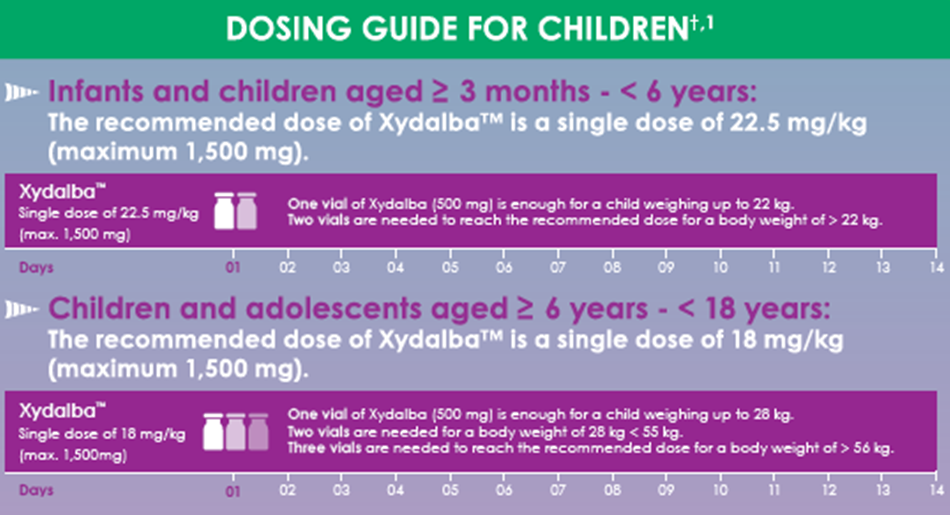
  • The recommended dose of Xydalba™ for infants and children aged >3 months to <6 years is a single dose of 22.5 mg/kg (maximum 1,500 mg).1
  • The recommended dose of Xydalba™ for adolescents aged >6 years to <18 years is a single dose of 18 mg/kg (maximum 1,500 mg).1


With:

  • No dose adjustments except for severe renal impairment,‡ and in infants and children (based on weight)1
  • No required TDM (Therapeutic Drug Monitoring), or blood cell, or CPK (creatinine phosphokinase) monitoring1
  • Low potential for drug-drug interactions#1
  • No weight-based dosing in adults1

For information around weight-based dosing for paediatric patients, refer to the SmPC.

Xydalba™ 30-minute infusion allows rapid administration and improved convenience9,18

The convenient dosing and administration of Xydalba™:

  • Facilitates the use of early discharge programmes9
  • Provides opportunity for cost and resource savings for your healthcare system9
  • Gives your patients the chance of less days in hospital9,18
  • 99% of surveyed physicians agreed that prolonged use of IV devices is the main reason for longer stays in hospital17

Although, a single, 30-minute infusion with Xydalba™ is preferred by patients,19 the two Xydalba™ dosing regimens deliver similar efficacy and safety.7

Reconstitution & dilution

Prior to administration, each vial of Xydalba™ must be reconstituted with 25 ml of sterile water for injections and then further diluted into a bag containing 5% glucose solution for infusion.1

A red circle with black text Description automatically generatedSodium chloride containing solutions can cause precipitation and should NOT be used for reconstitution or dilution.

For full reconstitution and dilution steps, refer to the SmPC.

*Clinical success defined as improvement in lesion size and resolution or improvement of clinical symptoms performed at day 14 and day 28.7

†There is insufficient information to recommend dosage adjustment for patients younger than 18 years with CrCL < 30 ml/min/1.73 m2. Currently available information is described in section 5.2 of the SmPC, but no recommendation on a posology can be made.

‡Caution should be exercised when prescribing Xydalba™ to patients with moderate or severe hepatic impairment (Child-Pugh Class B or C) as no data are available to determine the appropriate dosing in these patients.1

#Clinical drug-drug interaction studies with dalbavancin have not been conducted.1

CrCl=creatinine clearance.

Contents ^

Xydalba™ Safety & Tolerability

Xydalba™ delivers two weeks of fast-acting, effective treatment in one single dose, while remaining well-tolerated1

An analysis of 2,473 adult patients enrolled in Phase II/III trials receiving either the single or two-dose regimen of Xydalba™ showed that the most common adverse reactions were generally of mild or moderate severity1

A blue and white box with white text Description automatically generated

Contents ^


References
  1. Xydalba™. Summary of Product Characteristics. Available at: https://www.medicines.org.uk/emc/product/2270/smpc#gref. Accessed: September 2024.
  2. Leuthner KD, et al. Clinical efficacy of dalbavancin for the treatment of acute bacterial skin and skin structure infections (ABSSSI). Ther Clin Risk Manag. 2016;12:931-40.
  3. Malabarba A and Goldstein BP. Origin, structure, and activity in vitro and in vivo of dalbavancin. J Antimicrob Chemother. 2005;55(S2):ii15-ii20.
  4. Data on file. FDA Briefing Presentation. Anti-infective Drugs Advisory Committee Meeting. NDA 21-883. March 31, 2014.
  5. Smith JR, Roberts KD, Rybak MJ. Dalbavancin: A Novel Lipoglycopeptide Antibiotic with Extended Activity Against Gram-Positive Infections. Infect Dis Ther. 2015 Sep;4(3):245-58.
  6. Streit JM, et al. Activity against selected populations of antimicrobial-resistant Gram-positive pathogens. Diagn Microbiol Infect Dis. 2005 Dec;53(4):307-10.
  7. Dunne MW, et al. A Randomized Clinical Trial of Single Dose vs Weekly Dalbavancin for Treatment of Acute Bacterial Skin and Skin Structure Infection. Clin Infect Dis. 2016;62(5):545-51.
  8. Sader HS, et al. Antimicrobial susceptibility of Gram-positive cocci isolated from skin and skin-structure infections in European medical centres. Int J Antimicrob Agents. 2010;36:28-32.
  9. Marcellusi A, et al. Economic evaluation of the treatment of acute bacterial skin and skin structure infections (ABSSSIs) from the national payer perspective: introduction of a new treatment to the patient journey. A simulation of three European countries. Expert Rev Pharmacoecon Outcomes Res. 2019;4:1-19.
  10. Pfaller MA, et al. Activity of dalbavancin and comparator agents against Gram-positive cocci from clinical infections in the USA and Europe 2015-16. J Antimicrob Chemother. 2018;73(10):2748-2756.
  11. Bongiorno D, et al. In Vitro Activity of Dalbavancin against Refractory Multidrug-Resistant (MDR) Staphylococcus aureus Isolates. Antibiotics. 2020;9:865.
  12. The European Committee on Antimicrobial Susceptibility Testing. Breakpoint tables for interpretation of MICs and zone diameters. Version 11.0, 2021. http://www.eucast.org.
  13. Bai F, et al. Cost analysis of dalbavancin versus standard of care for the treatment of acute bacterial skin and skin structure infections (ABSSSIs) in two Italian hospitals. JAC Antimicrob Resist. 2023 Apr 19;5(2):dlad044.
  14. LoVecchio F, et al. Single Intravenous Dose Dalbavancin Pathway for the Treatment of Acute Bacterial Skin and Skin Structure Infections: Considerations for Emergency Department Implementation and Cost Savings. J Emerg Med. 2024;67(2): e217-e229.
  15. Boucher HW, et al. Once-Weekly Dalbavancin versus Daily Conventional Therapy for Skin Infection. N Engl J Med. 2014;370:2169-79.
  16. Almarzoky Abuhussain SS, et al. Patient preferences for treatment of acute bacterial skin and skin structure infections in the emergency department. BMC Health Services Res. 2018;18:932.
  17. Stargardt T, et al. Attitudes of physicians from 10 European countries on adherence and how treatment modalities in ABSSSI affffect adherence: results from a Delphi survey. Eur J Clin Microbiol Infect Dis. 2018;37:1611-1618.
  18. McCarthy MW, et al. Dalbavancin reduces hospital stay and improves productivity for patients with Acute Bacterial Skin and Skin Structure Infections: The ENHANCE Trial. Infect Dis Ther. 2020;9:53-67.
  19. Rappo U, et al. Single-dose dalbavancin and patient satisfaction in an outpatient setting in the treatment of acute bacterial skin and skin structure infections. J Global Antimicrob Resistance. 2019;17:60-65.


Contents ^

Xydalba® is promoted in the UK by ADVANZ PHARMA Limited. AbbVie Ltd is the Marketing Authorisation Holder.